
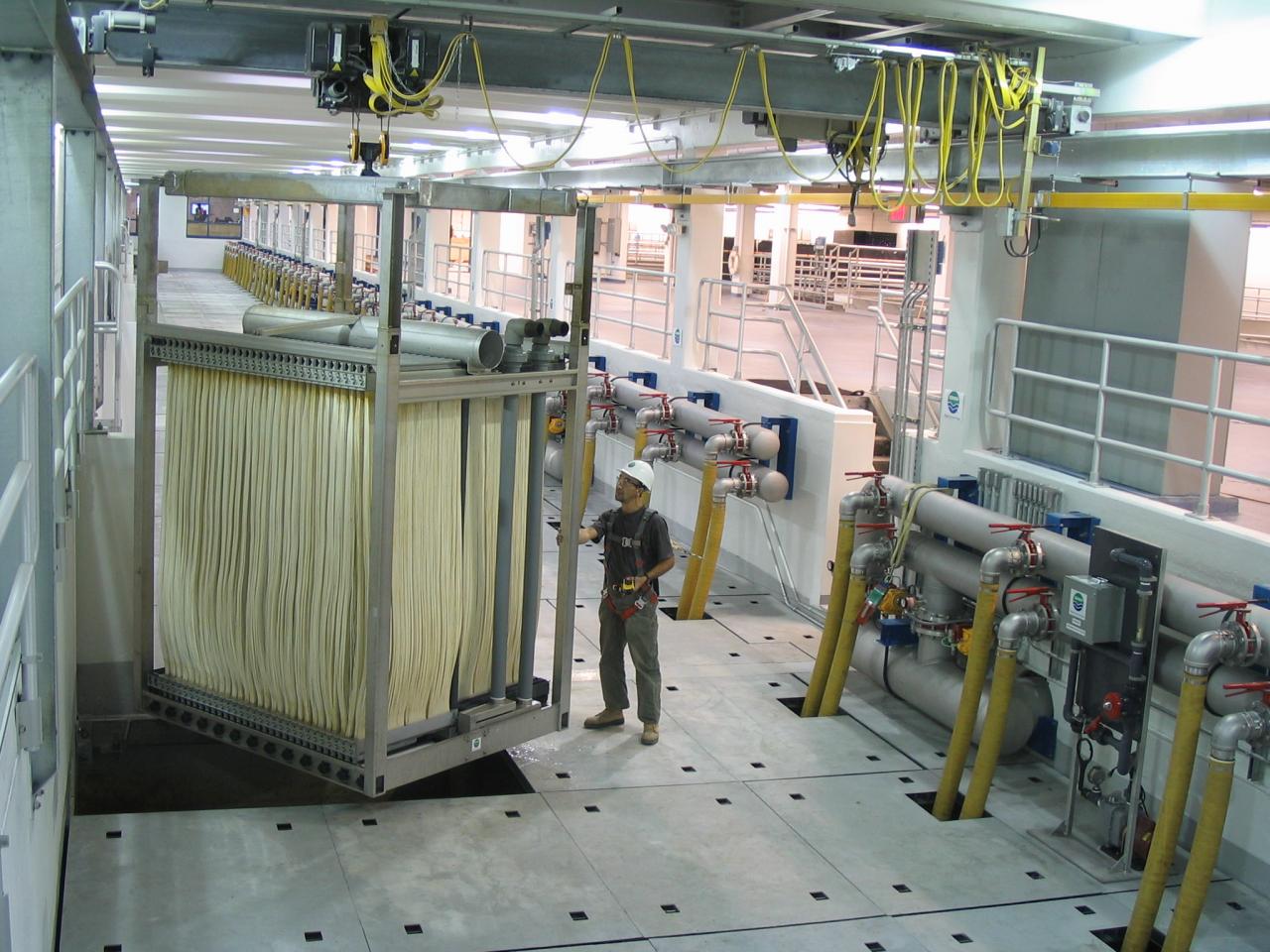
The primary purpose of air supply in the membrane housing tanks is the control of the polarization layer, or more precisely, the concentration gradient of activated sludge that forms on the fiber surface during the permeate extraction process.
An important technological innovation characterizing the ZeeWeed membranes has allowed equipping the ZW500D ultrafiltration cassettes with LEAPmbr technology. This technology is capable of ensuring continuous air injection at the base of the cassettes under all operating conditions (permeation, backwash, relaxation) without the need for cyclic pneumatic valves.
The first filtration devices introduced to the market were equipped with an ON/OFF valve system that alternated rapidly between ON and OFF moments, resulting in a discontinuous air flow to counteract the formation of the surface polarization layer. Although effective, this system had very high energy costs due to the large volumes of air required and caused significant wear on the cyclic valve system.
The LEAPmbr Aeration Technology system is an innovative coarse-bubble air diffuser located centrally at the base of the filtration device beneath the membrane modules. It is rectangular in shape and has opposing holes on the top, from which air supplied for membrane scouring exits and rises into the gap between two adjacent membrane modules.
Thanks to their patented structure, LEAP diffusers act like a reservoir, accumulating air inside and releasing it suddenly when the internal pressure equals the pressure of the overlying water column. In other words, the LEAP technology allows discontinuous aeration protocols to be implemented while operating the blowers continuously for membrane scouring without the need for pneumatic valves that cyclically direct air to one cassette (or train) or another.
Adopting LEAP technology also significantly simplifies the aeration system, which no longer needs to follow an ON/OFF air supply protocol for filtration devices and can simply consist of a supply pipe connected to each device’s air inlet.
Moreover, thanks to the larger bubble size produced by the LEAP diffuser compared to traditional air diffusers, and the particular mushroom-shaped bubble generated, the membranes are shaken and the sludge is removed from their surface more effectively with a significant reduction in the amount of air required. This air demand depends on the installed filtration surface, permeate flow rate, and the suspended solids concentration in the membrane tank. In other words, the air flow needed for membrane scouring depends on specific operating conditions.
Thanks to LEAP technology, there are two operational modes:
- LEAP-HI, used under the most demanding conditions (e.g., very high filtration flows or high suspended solids concentrations), and
- LEAP-LOW, where the air supplied is 50% of that required for LEAP-HI, used under normal operating conditions.
The LEAPmbr Aeration Technology offers the designer great flexibility in plant design. Since continuous air supply is possible for each filtration train, the system can be configured either with a dedicated blower per train or with a single air supply station shared by multiple filtration trains connected via a common distribution manifold.
In conclusion, the advantages of LEAP aeration technology include:
- 30% reduction in energy demand for membrane air supply;
- Elimination of valves for sequential aeration cycles;
- Always a single air distribution manifold per filtration train;
- Reduced diameter of the air distribution manifold;
- Increased membrane scouring effectiveness thanks to the presence of coarse bubbles.
Membrane Cleaning Cycles
Depending on the efficiency of the biological degradation section and the characteristics of the influent wastewater (alkalinity, hardness, etc.), organic fouling and inorganic scaling of the membranes must be addressed.
Two cleaning strategies have been defined to deal with membrane fouling:
- The first aims to keep clogging within acceptable limits and to contain the resulting loss of membrane permeability.
- The second, necessary when the first is insufficient, aims to restore the membranes’ initial permeability.
What are these two procedures and how are they performed?
- Maintenance Cleaning (MC): This procedure involves chemically enhanced backwash (CEB) performed by reversing the filtration flow while keeping the cassettes immersed in activated sludge.
- Recovery Cleaning (RC): This is performed by removing the activated sludge from the membrane tanks and filling them with aqueous solutions of appropriate reagents, in which the cassettes remain immersed for predetermined times. The filling operation is carried out by backflushing the chemical cleaning solution from inside the membranes outward until the tank is filled to its maximum volume.
The table below shows the typical execution frequencies, reagents used, and reagent concentrations for MC and RC cleaning cycles in MBR plants treating municipal wastewater:
| Cleaning Type | Sodium Hypochlorite | Citric Acid | Sodium Hypochlorite | Citric Acid |
|---|---|---|---|---|
| Frequency | 2 times/week | 1 time/week | 2-4 times/year | 1-2 times/year |
| Backwash Concentration | 200 ppm | 2000 ppm | 1100 ppm | 2200 ppm |
| Soaking Concentration | 1000 ppm | 2000 ppm |
Table 3 – Cleaning execution frequencies and reagent concentrations for MC and RC typical of municipal wastewater
The final cleaning strategy for a membrane filtration section cannot be set in advance but is developed during the first months of plant operation, depending on the actual quality of the influent liquor. For MBR plants treating industrial wastewater, cleaning cycle frequencies may increase.
Advantages of the ZeeWeed® MBR Solution
ZeeWeed membranes are fibers supported on a textile matrix: this reinforcement makes the membrane significantly more robust than unsupported types (monolithic, extruded, or unsupported) and capable of withstanding unparalleled stresses. The high toughness of ZeeWeed fibers provides a very robust barrier needed in high suspended solids concentration environments and under intense aeration typical of MBR plants.
ZeeWeed hollow fiber MBRs are more robust and operationally flexible for these reasons:
- Integration with the biological process: ZeeWeed hollow fiber membranes can be integrated into any biological system configuration, including Enhanced Nutrient Removal (ENR) plants and systems with membranes housed directly in the biological tank.
- TMP Range: ZeeWeed hollow fiber membranes can operate over a wide transmembrane pressure (TMP) range (up to 0.55 bar), allowing MBR operators more time to respond and restore normal plant operation.
- Module Inspection: ZeeWeed cassettes can be easily removed while the rest of the train remains operational. Each module can be extracted by simply unlocking its ON/OFF rail-mounted fixing system without removing protective covers or housing panels.
- Hydraulic Flow: ZeeWeed MBR plants are designed based on hydraulic flows validated by long-term experience with similar-sized plants.
- Aeration: ZeeWeed hollow fiber membranes operate with some of the lowest air requirements among submerged hollow fibers on the market. ZeeWeed MBR plants use LEAP technology, drastically reducing operating (energy) costs.
- Aerator Accessibility: ZeeWeed aerators are removable components of a cassette, easily accessible for inspection, reducing confined space risks for operator health and safety.
- Cleaning: Several advantages characterize ZeeWeed membranes regarding cleaning:
- Backpulse: ZeeWeed membranes operate at high TMP values that allow proper backwashing if needed, while their small pore size ensures uniform distribution of chemical solutions along the fiber length. ZeeWeed membranes do not require backwashing to maintain performance, but this feature provides maximum cleaning flexibility.
- Automation: ZeeWeed MBR plants include automated procedures for maintenance and recovery cleaning, allowing full automation of the cleaning process.
- In-situ Cleaning: In most applications, ZeeWeed membranes are housed in a tank separate from the biological process and are cleaned while still installed, without requiring removal and offsite cleaning. This avoids suspending biological line operation and ensures thorough filtration device cleaning.
- System Recovery: The ability to perform different protocols such as backpulsing and chemical soaking backwash allows full system recovery without removing membranes from their housing tanks.
