
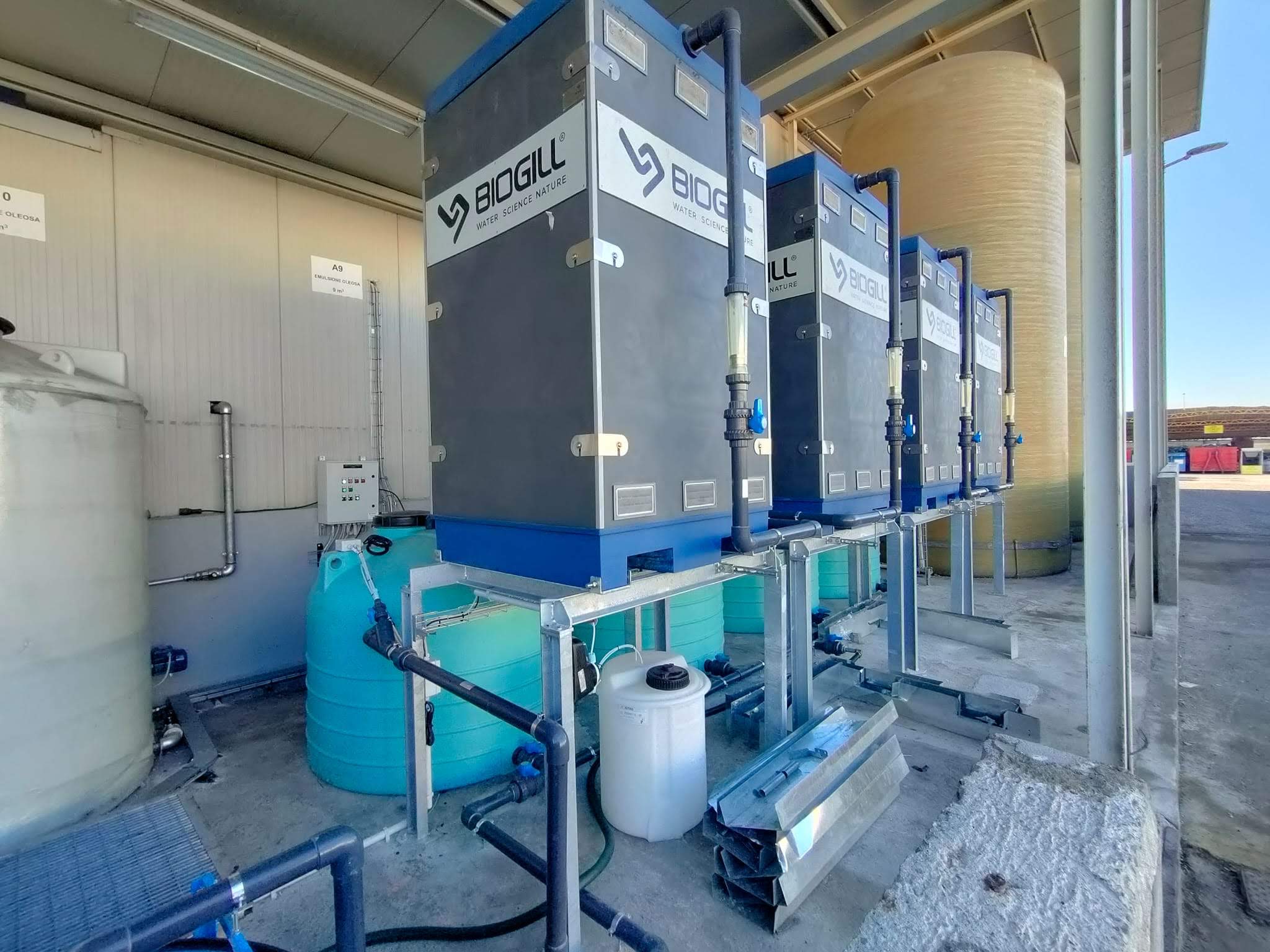
BioGill® technology was developed in the research laboratories of the Australian Nuclear Science and Technology Organisation (ANSTO), a Commonwealth research agency. ANSTO provides specialized consulting, scientific services, and products to government bodies, industry, academia, and other research organizations. A group of researchers from ANSTO’s Materials Engineering Institute was involved in innovative research on the use of nanoparticulate materials.
Between 2004 and 2009, the technology was further developed by ANSTO technicians in preparation for commercialization. In the following two years, the newly established BioGill® Environmental Pty Limited took charge of the industrialization and commercialization of the technology.
To date, BioGill® technology has proven effective on various types of industrial wastewater, such as from breweries and wineries, as well as municipal wastewater.
BioGill® technology provides the ideal conditions for biofilm growth to efficiently remove soluble organic nutrients. The oxygen-rich environment enables catabolic oxidation of organic compounds such as sugars and free fatty acids, along with ammonia oxidation and nitrification. Concurrent denitrification occurs within the biofilm and in the underlying treatment tank where anoxic conditions prevail, promoting the reduction of nitrates and nitrites to nitrogen gas, thus completing the nitrogen cycle.
The BioGill® design supports the growth of a diverse and complex ecosystem, including many species that cannot coexist in conventional systems. This is due to its unique mass transfer mode: the branched structure creates counter-diffusion of nutrients and oxygen. The resulting oxygen concentration gradient is the key factor enabling simultaneous carbon removal, nitrification, and denitrification under certain conditions. The advantage of this technology is ultimately a higher flow rate due to gaseous oxygen being delivered directly to the biofilm without passing through a liquid layer.
BioGill® bioreactors can be implemented in an infinite variety of configurations depending on treatment objectives and environmental conditions—such as batch, continuous flow, cascade, and multi-stage systems.
Part of the biomass grows as a biofilm in direct contact with air and is fed soluble nutrients through the porous medium. The biomass is not suffocated by water or oil, ensuring oxygen availability even in the presence of fats, oils, and grease.
An important feature of this mechanism allows the lipase activity of aerobic bacteria to degrade oil and grease without suffocating the biomass. Over time, the biofilm thins and rapidly settles in the underlying treatment tank.
The recirculation and settling tank provides retention time for the removal of soluble nutrients and acts as a clarifier, allowing suspended solids to settle at the bottom. These solids are periodically removed and managed as excess sludge.
The use of BioGill® systems has proven particularly effective for biological treatment of industrial wastewater with high BOD concentrations because its characteristics offer significant advantages:
- Easy installation, requiring minimal structures,
- Very compact footprint,
- Scalability due to system modularity,
- Fast start-up and very simple operation,
- Extremely low energy consumption.
BioGill® technology falls within the biological pollutant removal section. Other pre-treatment sections such as pH adjustment, suspended solids removal, oil separation, and nutrient balancing must be added if necessary to properly manage the plant and meet discharge limits.
Downstream of the BioGill® system, it may be necessary to install a section for suspended solids removal (excess sludge). In applications such as craft breweries, due to the technology’s characteristics, sludge production is much lower than in traditional activated sludge plants. The expected suspended solids concentration after treatment (excluding solids already separated during production) will be below legal limits for discharge into the public sewer and may not require further treatment.
The equalization tank receives wastewater from production after appropriate pretreatments to remove spent grains and yeasts. From the equalization tank, a pump feeds the BioGill® attached biomass treatment system and mixes the wastewater via a bypass that recirculates excess flow back into the tank. Downstream of equalization, a fine filtration system with manual emptying must be installed to ensure the removal of suspended solids larger than 0.5 mm before the water reaches the BioGill® unit. A pH probe linked to an automatic NaOH dosing system is installed on the feed line. The BioGill® unit is fed by a pump with manual mechanical flow control; the instantaneous flow rate is displayed and monitored by a meter connected to the electrical panel.
Assuming the client has adequately separated solids from production (spent grains), it is not necessary to install a sludge separation system downstream of the BioGill® towers because most sludge is retained within the recirculation tank, while excess in the final discharge remains below legal limits for sewer discharge. Periodically, sludge retained in the tank beneath the tower must be manually removed (from the surface or drained from the bottom) and disposed of as biological sludge. The frequency depends on pollutant load and system balance, typically every 15–30 days.
